




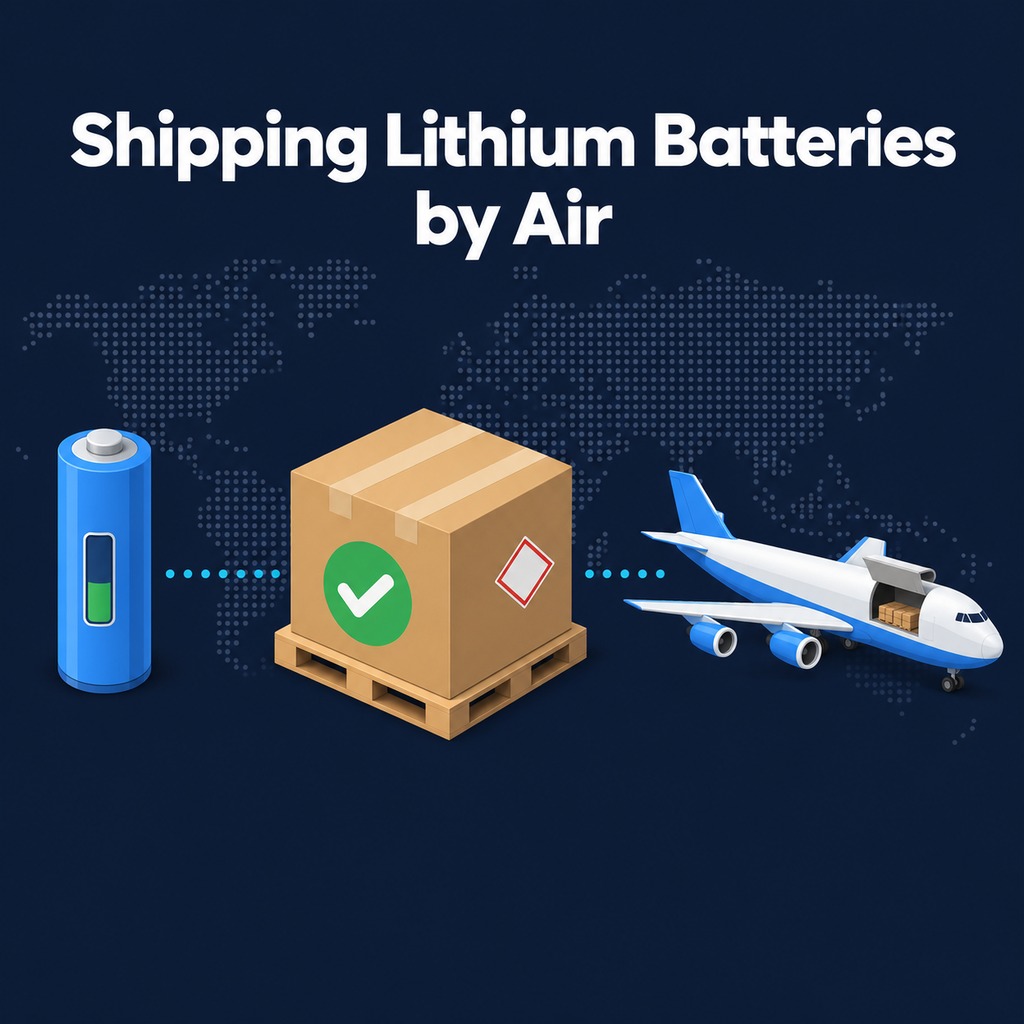
Lithium batteries can safely ship by air as regulated dangerous goods when they are correctly classified, packaged, marked, and documented under IATA Dangerous Goods Regulations (DGR) and ICAO technical instructions. Standalone lithium-ion batteries (UN3480) are strictly prohibited on passenger aircraft and must fly exclusively on dedicated cargo aircraft with a state of charge (SoC) not exceeding 30%.
Know Your Battery Classification
| UN Number | Proper Shipping Description | Core Air Transport Rules |
|---|---|---|
| UN 3480 | Lithium-ion batteries (shipped alone as individual power cells or packs) | Cargo Aircraft Only (CAO); maximum 30% State of Charge (SoC); Section IA, IB, or II packaging rules apply |
| UN 3481 | Lithium-ion batteries contained in or packed with equipment | Allowed on passenger and cargo aircraft within watt-hour (Wh) and quantity limits |
| UN 3090 | Lithium metal batteries (non-rechargeable, shipped alone) | Cargo Aircraft Only; strict cell/battery weight thresholds |
| UN 3091 | Lithium metal batteries contained in or packed with equipment | Permitted on passenger flights subject to net lithium content restrictions |
Key Rules for Air Shipments
- Cargo Aircraft Only (CAO) Handling: Dedicated CAO hazard labels are mandatory for all UN3480 consignments, and for UN3481 packages containing more than 5 kg net of lithium-ion batteries.
- UN 38.3 Testing Verification: Every cell and battery design must successfully pass UN 38.3 vibration, altitude simulation, thermal, and short-circuit tests. Manufacturers must provide a verifiable UN 38.3 Test Summary.
- Correct Packing Instructions (PI): Applicable packing instructions (such as PI 965, PI 966, or PI 967) dictate package construction, drop-test compliance (1.2 meters), and outer packaging ratings based on total Watt-hour (Wh) capacity.
- Terminal and Airline Acceptance: Damaged, defective, or recalled lithium batteries are forbidden from air transport under any circumstances.
Required Shipping Documentation
- Shipper's Declaration for Dangerous Goods (DGD): Required for all Section IA and IB shipments, signed by a certified dangerous goods handler.
- UN 38.3 Test Summary: Official test summary from the cell/battery manufacturer confirming laboratory test compliance.
- Technical Battery Specifications: Documentation specifying Watt-hour (Wh) rating, cell chemistry, voltage, and net weight.
- Air Waybill (AWB) and Commercial Invoice: The AWB must display the appropriate dangerous goods handling statement, UN number, and net quantity.
How Marinex Ships Dangerous Goods
Marinex Logistics is certified for Dangerous Goods (DG) Handling & Acceptance by IATA and operates as a TSA-certified Indirect Air Carrier (IAC). Our specialized air freight division manages hazardous materials, temperature-controlled cargo, and urgent commercial freight with strict compliance to global aviation security protocols. You can download our Lithium Battery Safety Document and IATA Dangerous Goods Declaration directly from our documents and forms section.
People Also Ask
Can you ship lithium batteries by air?
Yes, provided they comply with international dangerous goods regulations. Standalone lithium-ion batteries must fly on cargo aircraft at a maximum 30% state of charge, whereas batteries installed inside equipment may fly on passenger aircraft within established limits.
What is the difference between UN3480 and UN3481?
UN3480 applies to loose, standalone lithium-ion batteries (such as replacement power banks or battery modules). UN3481 applies to lithium-ion batteries packed alongside or pre-installed inside electronic devices (such as laptops, tools, or medical equipment).
What does a 30% state of charge mean?
State of charge (SoC) refers to the stored electrical energy relative to total battery capacity. Keeping charge at or below 30% significantly reduces the risk of thermal runaway and self-sustaining fire during flight.
Does every lithium battery shipment require a Dangerous Goods Declaration?
Fully regulated shipments (Section IA and IB) require a formal Shipper's Declaration for Dangerous Goods. Smaller consumer-grade batteries meeting Section II exceptions may travel under simplified documentation with lithium battery handling marks.
Ship Your High-Tech and Battery Cargo Safely:
Send our dangerous goods specialists your battery specifications and Material Safety Data Sheet (MSDS/SDS). We will identify the correct packing instruction and reserve optimal air routing. Explore our transportation services or request an air freight quote.